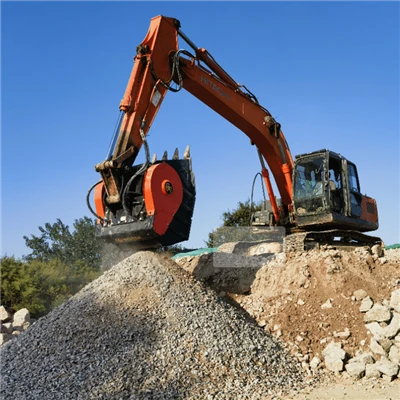
Hey there! As a supplier of Bucket Screeners, I often get asked about the vibration level of these machines during operation. It's a crucial aspect that can significantly impact the performance, efficiency, and even the lifespan of the equipment. So, let's dive right in and explore what the vibration level of a Bucket Screener is all about.
First off, why does vibration matter? Well, the right amount of vibration is essential for the proper functioning of a Bucket Screener. It helps in separating different materials effectively. When the Bucket Screener is in operation, the vibration causes the materials inside the bucket to move around. This movement allows smaller particles to pass through the screening mesh while larger ones are retained, achieving the screening process.
Now, the vibration level of a Bucket Screener isn't a fixed number. It can vary depending on several factors. One of the primary factors is the type of material being screened. For instance, if you're screening fine sand, you might need a different vibration level compared to when you're dealing with large rocks or gravel. Fine materials usually require a lower vibration level to prevent them from being blown away or to ensure a more precise screening. On the other hand, larger and heavier materials may need a higher vibration level to break up clumps and move them around the bucket.
Another factor that affects the vibration level is the design and construction of the Bucket Screener itself. Different models are engineered to produce different levels of vibration. Some Bucket Screeners are equipped with advanced vibration systems that can be adjusted according to the specific requirements of the job. These adjustable systems allow operators to fine - tune the vibration level for optimal performance.
The power source of the Bucket Screener also plays a role. Hydraulic - powered Bucket Screeners, for example, can generate a wide range of vibration levels depending on the hydraulic pressure and flow rate. Electric - powered ones may have a more consistent vibration output, but they also need to be properly calibrated to match the job at hand.
So, how do we measure the vibration level of a Bucket Screener? Usually, it's measured in terms of amplitude and frequency. Amplitude refers to the maximum displacement of the vibrating parts of the bucket from their resting position. A larger amplitude means a more intense vibration. Frequency, on the other hand, is the number of vibrations per unit of time, typically measured in Hertz (Hz). The combination of amplitude and frequency determines the overall vibration level of the Bucket Screener.
Let's talk about the ideal vibration levels for different applications. For general construction and landscaping projects where you're screening soil, gravel, or small stones, a medium - amplitude and medium - frequency vibration is often sufficient. This allows for efficient screening without causing excessive wear and tear on the equipment.
If you're working in a mining or quarrying environment, where you're dealing with harder and larger materials, a higher amplitude and frequency might be required. This can help in breaking down the materials and ensuring a more thorough screening process.
Now, as a Bucket Screener supplier, we offer a wide range of products to meet different vibration level requirements. Our Screener Bucket for Skid Steer is designed to be highly versatile. It can be adjusted to produce different vibration levels, making it suitable for various tasks, whether it's small - scale landscaping or light - duty construction work.
Our Mineral Screening Bucket is specifically engineered for more demanding applications. It has a robust vibration system that can handle the tough job of screening minerals and large rocks. The high - performance vibration ensures that the materials are screened efficiently, increasing productivity.
And for those who need a Bucket Screener for larger loaders, our Screening Bucket for Loader is the perfect choice. It can generate a powerful vibration to deal with large volumes of materials, making it ideal for big - scale construction and mining projects.
Maintaining the right vibration level is also crucial for the longevity of the Bucket Screener. Excessive vibration can cause premature wear on the moving parts, such as the bearings and the screening mesh. It can also lead to increased noise levels and even pose a safety risk to the operators. On the other hand, too little vibration may result in inefficient screening, which can slow down the project and increase costs.
Regular maintenance of the Bucket Screener is essential to ensure that the vibration system is working properly. This includes checking the hydraulic or electric components, lubricating the moving parts, and inspecting the screening mesh for any signs of damage.
If you're in the market for a Bucket Screener, it's important to consider your specific needs in terms of vibration level. Think about the type of materials you'll be screening, the scale of your projects, and the level of adjustability you require. Our team of experts is always ready to help you choose the right Bucket Screener with the appropriate vibration level for your job.
Whether you're a small - scale contractor or a large - scale mining company, we have the right solution for you. Don't hesitate to reach out to us if you have any questions or if you're interested in discussing a potential purchase. We can provide you with detailed information about our products, including the vibration levels they can achieve, and help you make an informed decision.
In conclusion, the vibration level of a Bucket Screener is a complex but vital aspect of its operation. It's influenced by multiple factors, and getting it right can make a huge difference in the efficiency and effectiveness of your screening projects. So, if you're looking for a high - quality Bucket Screener that can deliver the perfect vibration level for your needs, look no further. Let's start a conversation and find the best solution for your business.


References
- Engineering textbooks on construction equipment vibration analysis
- Manufacturer's manuals for Bucket Screeners
- Industry reports on the performance of different Bucket Screener models