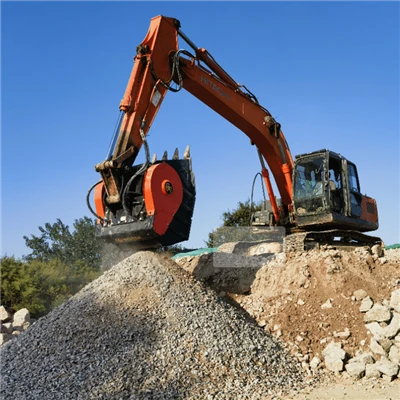
Hey there! As a supplier of soil mixing machines, I often get asked how these nifty pieces of equipment ensure uniform mixing. Well, strap in because I'm about to break it down for you.


First off, let's talk about why uniform mixing is so important. Whether you're working on Soil Decontamination, soil stabilization, or any other soil - related project, having a well - mixed soil blend is crucial. In soil decontamination, for example, you need to evenly distribute the decontaminating agents throughout the soil to effectively neutralize pollutants. And when it comes to Soil Stabilization Products, a uniform mix ensures that the stabilizing agents work consistently across the entire soil mass, providing the desired strength and durability.
So, how does a soil mixing machine achieve this uniformity? Let's start with the design of the mixing chamber. A good soil mixing machine has a carefully engineered mixing chamber that promotes efficient and thorough mixing. The shape of the chamber is designed to create a specific flow pattern for the soil and additives. For instance, some chambers are cylindrical, which allows the soil to rotate in a circular motion. As the soil moves around, it constantly interacts with the mixing blades, ensuring that all parts of the soil come into contact with the additives.
The mixing blades are another key component. These blades are usually made of high - strength materials like hardened steel to withstand the abrasive nature of soil. They come in various shapes and sizes, each designed for a specific purpose. Some blades are flat and wide, which are great for pushing and spreading the soil, while others are curved or angled to create a shearing action. This shearing action helps to break up large clumps of soil and disperse the additives more evenly.
Most modern soil mixing machines also come with adjustable blade settings. This means that you can change the speed, angle, and depth of the blades according to the type of soil and the specific requirements of your project. If you're dealing with heavy clay soil, for example, you might want to set the blades to a slower speed but a greater depth to break through the dense soil structure. On the other hand, for sandy soil, a faster blade speed might be sufficient to mix in the additives.
Another important feature is the feeding system. A proper feeding system ensures that the soil and additives are introduced into the mixing chamber at a consistent rate. This is crucial for uniform mixing. Some machines use a conveyor belt system to feed the soil into the chamber, while others have hoppers with controlled gates. These gates can be adjusted to regulate the flow of soil and additives, ensuring that they are added in the correct proportions.
The addition of additives is also carefully controlled. In many cases, additives are stored in separate containers and are metered into the mixing chamber using a pump or a dosing system. This allows for precise control of the amount of additives being added, which is essential for achieving a uniform mix. For example, if you're using a chemical stabilizer, you need to make sure that the right amount is added to each batch of soil to ensure consistent results.
Now, let's talk about the role of technology in ensuring uniform mixing. Many of our soil mixing machines are equipped with advanced sensors and control systems. These sensors can monitor various parameters such as the moisture content, density, and particle size of the soil. Based on this data, the control system can automatically adjust the mixing process. For example, if the moisture content is too high, the system might increase the blade speed to help dry out the soil slightly during the mixing process.
Some machines also have built - in feedback loops. These loops continuously analyze the quality of the mixed soil and make real - time adjustments to the mixing process. If the system detects that the mix is not uniform, it can adjust the blade settings, the feeding rate, or the additive dosage to correct the problem.
In addition to the design and technology of the machine itself, proper operation and maintenance are also crucial for ensuring uniform mixing. Operators need to be trained to use the machine correctly. They should understand how to set the parameters based on the soil type and project requirements. Regular maintenance is also essential. This includes checking and replacing worn - out blades, lubricating moving parts, and cleaning the mixing chamber. A well - maintained machine will perform better and ensure more consistent mixing results.
When it comes to different types of soil mixing machines, there are a few options available. Continuous - flow soil mixing machines are great for large - scale projects. They can mix soil and additives continuously as they are fed into the machine. This allows for a high - volume production of uniformly mixed soil. On the other hand, batch - type soil mixing machines are more suitable for smaller projects or when you need to have more control over each individual batch. With batch - type machines, you can mix a specific amount of soil and additives at a time, ensuring that each batch meets your exact requirements.
So, whether you're in the market for Soil Stabilization Equipment for a big construction project or a small - scale soil improvement job, a well - designed soil mixing machine can make all the difference. It ensures that your soil is uniformly mixed, which leads to better project outcomes, whether it's stronger foundations, cleaner soil, or more stable slopes.
If you're interested in learning more about our soil mixing machines or are thinking about making a purchase, we'd love to hear from you. Just reach out to us, and we'll be happy to discuss your project needs and help you find the perfect soil mixing solution for you.
References
- Engineering Principles of Soil Mixing, [Author's Name], [Publication Date]
- Soil Stabilization Handbook, [Author's Name], [Publication Date]