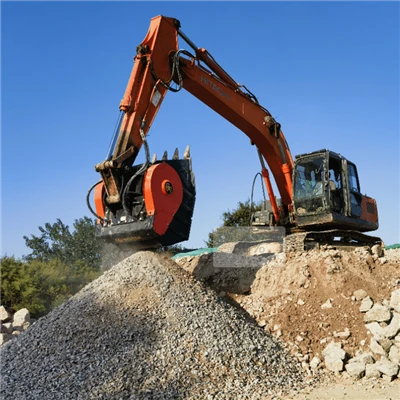
In the realm of construction and mining, the Bucket Jaw Crusher stands as a pivotal piece of equipment, revolutionizing the way we handle and process materials. At the heart of its operation lies the flywheel, a component that plays a multifaceted and crucial role. As a leading supplier of Bucket Jaw Crushers, I am delighted to delve into the significance of the flywheel and its impact on the overall performance of these remarkable machines.
Understanding the Basics of a Bucket Jaw Crusher
Before we explore the role of the flywheel, let's briefly understand what a Bucket Jaw Crusher is. A Bucket Jaw Crusher is a versatile attachment that can be fitted to various types of heavy machinery such as excavators, skid steers, and backhoes. It is designed to crush large rocks, concrete, and other materials on-site, eliminating the need for transporting these materials to a separate crushing facility. This not only saves time and money but also reduces the environmental impact associated with transportation.
The Bucket Jaw Crusher operates on the principle of compression. It consists of a fixed jaw and a movable jaw. The movable jaw moves back and forth against the fixed jaw, creating a crushing action that breaks the material into smaller pieces. The size of the crushed material can be adjusted by changing the gap between the jaws.
The Role of the Flywheel in a Bucket Jaw Crusher
Energy Storage and Release
One of the primary functions of the flywheel in a Bucket Jaw Crusher is energy storage and release. When the crusher is in operation, the flywheel stores kinetic energy during the non - crushing phase. As the movable jaw moves towards the fixed jaw to crush the material, the stored energy in the flywheel is released. This additional energy helps to overcome the resistance of the material being crushed, ensuring a smooth and efficient crushing process.
The flywheel acts as a buffer, absorbing excess energy when the load on the crusher is low and releasing it when the load is high. This helps to maintain a consistent speed and power output, preventing the engine from stalling or overloading. For example, when a large piece of rock enters the crusher, the flywheel provides the extra power needed to break it down, while during the idle periods between crushing cycles, it stores energy for the next crushing operation.
Maintaining Consistent Speed
The flywheel also plays a crucial role in maintaining a consistent speed of the crusher. In a Bucket Jaw Crusher, the speed of the movable jaw is critical for efficient crushing. If the speed is too slow, the crushing process will be inefficient, and if the speed is too fast, it can cause excessive wear and tear on the components.
The flywheel helps to regulate the speed of the crusher by reducing speed fluctuations. It does this by its inertia. Inertia is the property of an object to resist changes in its state of motion. The large mass and diameter of the flywheel give it a high moment of inertia. When the load on the crusher changes, the flywheel resists the change in speed, ensuring that the crusher operates at a relatively constant speed. This consistent speed not only improves the quality of the crushed material but also extends the lifespan of the crusher components.
Smoothing Out Vibration
Vibration is an inevitable part of the operation of a Bucket Jaw Crusher. The impact of the movable jaw on the material being crushed generates vibrations that can be transmitted to the entire machine and the attached equipment. Excessive vibration can cause damage to the crusher components, reduce the efficiency of the machine, and even pose a safety hazard.
The flywheel helps to smooth out these vibrations. Its large mass and rotational motion act as a counter - balance, canceling out some of the vibrations generated during the crushing process. By reducing vibrations, the flywheel improves the stability of the crusher, reduces noise levels, and prolongs the life of the crusher and its associated components.
Impact on Crusher Performance
The presence of a well - designed flywheel has a significant impact on the overall performance of a Bucket Jaw Crusher. A properly sized and balanced flywheel can increase the crushing capacity of the crusher. By providing additional energy during the crushing phase, it allows the crusher to handle larger and harder materials more effectively.


It also improves the efficiency of the crusher. The consistent speed and power output ensured by the flywheel result in a more uniform crushing process, reducing the amount of uncrushed material and improving the quality of the final product. Moreover, the reduced vibrations and wear and tear on the components lead to lower maintenance costs and longer equipment life.
Types of Flywheels in Bucket Jaw Crushers
There are different types of flywheels used in Bucket Jaw Crushers, each with its own characteristics and advantages. Some flywheels are made of cast iron, which is a common and cost - effective material. Cast iron flywheels are heavy and have a high moment of inertia, making them suitable for storing and releasing large amounts of energy.
Other flywheels are made of steel. Steel flywheels are lighter than cast iron flywheels but have a higher strength - to - weight ratio. They can be designed to store a large amount of energy in a relatively small space, making them ideal for applications where space is limited.
Choosing the Right Flywheel for Your Bucket Jaw Crusher
As a supplier of Bucket Jaw Crushers, we understand the importance of choosing the right flywheel for your specific application. The size, weight, and material of the flywheel should be carefully selected based on the capacity, power, and operating conditions of the crusher.
For smaller Bucket Jaw Crushers, such as the Skid Steer Crusher, a lighter flywheel may be sufficient to provide the necessary energy and maintain a consistent speed. On the other hand, larger crushers, like the Large Jaw Crusher, require a heavier and more robust flywheel to handle the higher loads and larger materials.
Our team of experts can help you determine the most suitable flywheel for your Bucket Jaw Crusher. We offer a wide range of flywheels with different specifications to meet the diverse needs of our customers. Whether you are looking for a flywheel for a small - scale construction project or a large - scale mining operation, we have the right solution for you.
The Motek - MTC200 and Flywheel Technology
One of our popular products, the Motek - MTC200, is equipped with a state - of - the - art flywheel technology. The flywheel in the Motek - MTC200 is carefully designed to optimize energy storage and release, ensuring maximum crushing efficiency. It is made of high - quality materials that can withstand the rigors of continuous operation, providing long - term reliability and performance.
The Motek - MTC200's flywheel also contributes to the machine's smooth operation and low vibration levels. This not only improves the operator's comfort but also reduces the wear and tear on the components, resulting in lower maintenance costs and longer service intervals.
Conclusion
In conclusion, the flywheel is an essential component of a Bucket Jaw Crusher. Its role in energy storage and release, maintaining consistent speed, and smoothing out vibrations cannot be overstated. A well - designed flywheel can significantly improve the performance, efficiency, and reliability of the crusher, making it a valuable investment for any construction or mining project.
As a leading supplier of Bucket Jaw Crushers, we are committed to providing our customers with high - quality products and exceptional service. Our range of crushers, including the Motek - MTC200, Skid Steer Crusher, and Large Jaw Crusher, are equipped with advanced flywheel technology to ensure optimal performance.
If you are interested in learning more about our Bucket Jaw Crushers or need help in choosing the right flywheel for your application, we encourage you to contact us. Our team of experts is ready to assist you in making the best decision for your business. Let's work together to achieve your crushing goals and take your operations to the next level.
References
- "Crushing Equipment Handbook" - A comprehensive guide to the design, operation, and maintenance of crushing equipment.
- "Principles of Mechanical Engineering in Mining and Construction" - A textbook that covers the fundamental principles of mechanical engineering as applied to the mining and construction industries.
- Industry reports and research papers on the performance and technology of Bucket Jaw Crushers.