


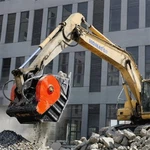


Large Jaw Crusher
Anhui Motek Construction Machinery Co., Ltd. is top manufacturer in China on construction machinery attachments, established in 2014. We have two gantry machining centers, which can easily cope with the processing of large and complex parts with high precision and large stroke, ensuring that every detail is accurate.
Rich Product Variety
Our company has crushing buckets, screening buckets, soil stabilization systems, skid steer loader screening buckets, excavator crushing buckets, rock screening buckets, crusher bucket accessories, loader screening buckets, excavator screening buckets, etc.
Wide Range of Product Uses
Our screening buckets are widely used in soil remediation, solid waste treatment and other fields to screen and crush materials. Crusher buckets are mainly used for fine crushing of bulk materials and are one of the common accessories in construction machinery.
Advanced Equipment
We have two gantry machining centers, which can easily cope with the processing of large and complex parts with high precision and long stroke, ensuring the accuracy of every detail. And CNC lathes have advanced control systems and multi-axis linkage functions, which can process parts with complex shapes and high precision requirements.
Leading Service
We have many years of industry experience and a complete production management, quality supervision, sales service operation system. Whether you want to buy a screening bucket or a crushing bucket, just send your requirements by email and we can customize the product for you.

A Jaw Crusher for Excavator, also known as an excavator-mounted jaw crusher bucket, is a versatile attachment designed to crush a wide range of materials, including rock, concrete, and asphalt, directly at the construction or demolition site. This powerful tool significantly enhances the capabilities of excavators, making them more effective for material processing and management.

An Excavator Crusher Bucket, often referred to simply as a crusher bucket, is a versatile piece of machinery designed as an attachment for excavators. Its primary function is to crush, grind, and break down a variety of materials directly from the construction site.

A Crusher Bucket Attachment is a specialized piece of equipment designed to fit onto excavators, backhoes, and other heavy machinery. Its primary function is to crush, grind, and pulverize various types of materials, such as concrete, asphalt, stone, and demolition waste, directly at the construction site. This innovative attachment offers significant advantages in terms of efficiency, cost-effectiveness, and sustainability.

A Bucket Crusher, also known as a concrete crusher bucket, is a specialized attachment designed to fit onto excavators, skid steers, and similar heavy machinery. Its primary function is to crush and reduce concrete, asphalt, and other hard materials directly on-site. This innovative tool has gained popularity in construction, demolition, and recycling projects due to its efficiency and versatility.

Concrete Crusher Bucket for Excavator
A Concrete Crusher Bucket, specifically designed for excavators, is an attachment that transforms the way construction and demolition waste is processed. It is a powerful tool for on-site material management, offering a sustainable and efficient solution to crushing concrete and other hard materials.

A Crusher Bucket Excavator is a specialized attachment designed to enhance the capabilities of excavators in construction, demolition, and recycling projects. It combines the mobility and power of an excavator with the functionality of an on-site crushing unit, allowing for efficient processing of various materials directly at the project site.

A Crusher Bucket Mini Excavator is a specialized attachment designed to fit onto smaller, more compact excavators, often used in tight spaces or on smaller-scale projects. It brings the powerful functionality of a crusher to mini excavators, allowing for the on-site processing of various materials such as concrete, asphalt, and stone.

An Excavator Jaw Crusher Bucket is a specialized attachment designed for excavators, primarily used to crush rocks, concrete, and other hard materials on construction and demolition sites. This innovative tool significantly enhances the efficiency and versatility of excavators by enabling on-site material processing.

A Jaw Rock Crusher is a primary type of crusher used in the first stage of size reduction of rock, stone, and other materials. It's a fundamental piece of equipment in the mining and construction industry, designed to break down large pieces of material into smaller, manageable sizes.
What Is Large Jaw Crusher
A Large Jaw Crusher is a powerful and heavy-duty machine used in the primary stage of crushing in various industries, primarily mining, construction, and aggregate production. It is designed to handle large feed sizes and high volumes of hard and abrasive materials.
Features of Large Jaw Crusher
Efficient Crushing
The mechanical advantage of jaw crushers ensures efficient crushing of even the hardest rocks. This efficiency is crucial in construction projects where large volumes of material need to be processed swiftly.
Versatility in Materials
One of the key advantages of jaw crushers is their ability to crush a wide range of materials, including hard and abrasive ones. From granite to basalt, jaw crushers can handle diverse types of rocks, making them indispensable in various applications.
Uniform End Product
Jaw crushers produce uniform and consistent crushed materials. This uniformity is vital in construction projects, especially in the production of concrete and asphalt, where consistent particle size is essential for the structural integrity of the final product.
Reduced Downtime
Modern jaw crushers are designed for reliability and reduced maintenance. This design focus minimizes downtime, ensuring that construction projects proceed smoothly without unnecessary interruptions.
Cost-Effectiveness
Jaw crushers offer excellent cost-effectiveness due to their high efficiency and low operational costs. They require relatively little power to operate, making them economical choices for construction companies aiming to optimize their budgets.
Adaptability to Various Settings
Jaw crushers can be easily adjusted to different settings to produce various sizes of crushed materials. This adaptability allows construction professionals to meet specific project requirements without investing in multiple types of crushers.
Environmentally Friendly
Some jaw crushers are designed with advanced features to reduce environmental impact. Dust and noise control measures contribute to a more eco-friendly operation, aligning with modern environmental standards.
At its core, the jaw crusher operates on a simple yet powerful principle. When the machine is in operation, the motor drives the belt and the pulley, making the movable jaw move back and forth along a predetermined track. The rocks or ores fed into the jaw crusher are gradually crushed as they pass through the narrowing space between the two heavy jaws. The crushing process continues until the materials are small enough to pass through the gap at the bottom of the jaws.
How to Choose Large Jaw Crusher


Robust Construction
One of the most critical aspects of a jaw crusher is its ability to withstand the extreme forces and abrasive conditions inherent in the crushing process. A well-constructed jaw crusher should be built to last, withstanding the rigors of continuous operation while minimizing downtime and maintenance requirements.
High Crushing Capacity
The primary function of a jaw crusher is to reduce the size of input materials efficiently. As such, its crushing capacity is a crucial factor to consider. A crusher with a higher capacity can process larger volumes of material in a given timeframe, translating into increased productivity and potential cost savings.
Feed Opening Size
The size of the feed opening, or the gap between the fixed and movable jaw plates, determines the maximum size of material that can be fed into the crusher. A larger opening allows for more significant input materials, resulting in higher throughput rates.
Eccentric Shaft Speed
The eccentric shaft, which drives the movable jaw, operates at a specific speed. Higher speeds generally correspond to increased crushing capacity, though excessive speeds can lead to accelerated wear and potential damage.
Toggle Plate Design
The shape and configuration of the toggle plate, which transmits force from the eccentric shaft to the movable jaw, can significantly impact the crusher's ability to handle large loads. Optimized designs can enhance capacity while minimizing stress on the components.
Adjustable Settings
Flexibility is a desirable trait in jaw crushers, as it allows operators to adapt to changing input materials and desired output sizes. Modern jaw crushers typically feature adjustable settings that enable fine-tuning of the crushing process.
Closed-Side Setting Adjustment
By adjusting the closed-side setting, or the minimum distance between the fixed and movable jaws, operators can control the output size of the crushed material. This feature is particularly useful when specific particle sizes are required for downstream processes or product specifications.
Stroke Length Adjustment
The stroke length, or the distance the movable jaw travels during each cycle, can also be adjusted to accommodate varying feed rates. Increasing the stroke length can enhance throughput, while decreasing it can improve product gradation and reduce wear on the crusher components.
How to Maintain Large Jaw Crusher
Regular Inspection
Jaw crusher parts should be regularly inspected for signs of wear or damage. Any worn-out or damaged parts should be identified, removed, and replaced with new ones. Additionally, periodic lubrication of bearings and other moving parts can extend the life of the jaw crusher. You can find this information in the manual, on the manufacturer's website, or get it directly from the manufacturer.
Cleaning
Jaw crusher components such as bearings, gears, shafts, and others should be properly cleaned to remove dirt or debris before being lubricated or replaced. Failing to clean these components may result in excessive wear or failure due to buildups in the system.
Maintaining
Jaw crusher parts like springs, toggle plate, pitman arm, should also be checked routinely for any signs of wear or damage and replaced if necessary. In addition, it is essential that all fasteners used on the jaw crusher be kept tight so that they do not loosen over time due to vibration caused by the operation of the machine itself.
Greasing
Jaw crusher bearings should be greased periodically to maintain proper performance and minimize wear on these components over time. Additionally, grease points should also be checked when replacing worn-out parts since improper greasing leads to inferior performance and additional wear on the equipment.
Aligning
Jaw plates need to be aligned accurately for them to work together efficiently and effectively during crushing operations. This makes it important that all alignment issues are addressed whenever replacing worn-out or damaged parts on a jaw crusher system. This ensures optimum performance from the equipment as well as minimizes long-term maintenance requirements associated with its use.
Mining Industry
One of the most common applications of jaw crushers is in the mining industry to crush large rocks into smaller pieces. They are used to crush ores such as iron, copper, gold, and silver. These machines are used to reduce the size of ore in preparation for further processing and refining. The crushing process helps to separate valuable minerals from the waste rock, making it easier to extract and process the valuable materials. Jaw crushers are also used in the coal industry, where they are used to crush coal before it is processed and transported to power plants or other end users.
Quarrying Industry
Jaw crushers are used in the quarrying industry to crush large rocks into smaller pieces. They are used to crush stone, concrete, and asphalt for use in construction projects.
Construction Industry
Jaw crushers are also commonly used in the construction industry, where they are used to crush materials such as concrete and asphalt for use in road construction and building projects. These machines are particularly useful for recycling materials, as they can break down old concrete and asphalt into smaller pieces that can be reused in new construction projects.
Recycling Industry
Another application field for jaw crushers is in the recycling industry to crush concrete, asphalt, and other construction materials. These machines are used to crush a wide range of materials, including glass, plastic, metal, and paper, for use in the production of new products. Jaw crushers are particularly effective at breaking down materials that are difficult to recycle, such as electronic waste and construction waste.
Certificate

Frequently Asked Questions
Hot Tags: large jaw crusher, China large jaw crusher manufacturers, suppliers, factory, crusher bucket crushing, crusher bucket slag crushing, Bucket Rock Crusher, crusher bucket trend, crusher bucket value added crusher bucket, crusher bucket leak proof crusher bucket
Previous
Small Jaw CrushersYou Might Also Like


Send Inquiry