


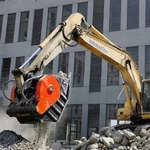


Big Jaw Crusher
Anhui Motek Construction Machinery Co., Ltd. is top manufacturer in China on construction machinery attachments, established in 2014. We have two gantry machining centers, which can easily cope with the processing of large and complex parts with high precision and large stroke, ensuring that every detail is accurate.
Rich Product Variety
Our company has crushing buckets, screening buckets, soil stabilization systems, skid steer loader screening buckets, excavator crushing buckets, rock screening buckets, crusher bucket accessories, loader screening buckets, excavator screening buckets, etc.
Wide Range of Product Uses
Our screening buckets are widely used in soil remediation, solid waste treatment and other fields to screen and crush materials. Crusher buckets are mainly used for fine crushing of bulk materials and are one of the common accessories in construction machinery.
Advanced Equipment
We have two gantry machining centers, which can easily cope with the processing of large and complex parts with high precision and long stroke, ensuring the accuracy of every detail. And CNC lathes have advanced control systems and multi-axis linkage functions, which can process parts with complex shapes and high precision requirements.
Leading Service
We have many years of industry experience and a complete production management, quality supervision, sales service operation system. Whether you want to buy a screening bucket or a crushing bucket, just send your requirements by email and we can customize the product for you.

A Bucket Crusher, also known as a concrete crusher bucket, is a specialized attachment designed to fit onto excavators, skid steers, and similar heavy machinery. Its primary function is to crush and reduce concrete, asphalt, and other hard materials directly on-site. This innovative tool has gained popularity in construction, demolition, and recycling projects due to its efficiency and versatility.

A Crusher Bucket Attachment is a specialized piece of equipment designed to fit onto excavators, backhoes, and other heavy machinery. Its primary function is to crush, grind, and pulverize various types of materials, such as concrete, asphalt, stone, and demolition waste, directly at the construction site. This innovative attachment offers significant advantages in terms of efficiency, cost-effectiveness, and sustainability.

Concrete Crusher Bucket for Excavator
A Concrete Crusher Bucket, specifically designed for excavators, is an attachment that transforms the way construction and demolition waste is processed. It is a powerful tool for on-site material management, offering a sustainable and efficient solution to crushing concrete and other hard materials.

An Excavator Crusher Bucket, often referred to simply as a crusher bucket, is a versatile piece of machinery designed as an attachment for excavators. Its primary function is to crush, grind, and break down a variety of materials directly from the construction site.

A Digger Crusher Bucket, often synonymous with an excavator crusher bucket, is a specialized attachment designed to fit onto a digger or excavator. Its purpose is to crush, grind, and reduce various types of materials, such as concrete, asphalt, rock, and waste, directly on construction and demolition sites.
Concrete Crusher Bucket for Excavator
A Concrete Crusher Bucket, specifically designed for excavators, is an attachment that transforms the way construction and demolition waste is processed. It is a powerful tool for on-site material management, offering a sustainable and efficient solution to crushing concrete and other hard materials.

Motek rock crusher jaws can maintain a stable working state under various complex working conditions, and is not affected by external factors such as temperature and humidity.

The jaw plate is a consumable part, Motek small jaw crushers have designed a convenient replacement method. The jaw plate can be replaced in a short time, reducing equipment downtime.

Motek bucket jaw crusher is suitable for crushing a variety of materials, including rocks, concrete, bricks, ores, etc. It plays an excellent role in the fields of building demolition, mining and road construction.
What Is Big Jaw Crusher
A Big Jaw Crusher is a heavy-duty piece of equipment used primarily in the mining, construction, and aggregate industries to reduce the size of large rocks and ore. It is the first stage in the process of crushing materials, designed to handle high pressure and large volumes.
High Crushing Ratio
One of the key features of jaw crusher design is its high crushing ratio. The crushing ratio is the ratio of the size of the feed material to the size of the crushed product. Jaw crushers are designed with a high crushing ratio to ensure that they can effectively reduce the size of large rocks and minerals into smaller particles. This means that the machine can crush a large volume of material in a single pass, which makes it ideal for use in industries where a high throughput is required.
Simple Design
Another key feature of jaw crusher design is its simple design. Jaw crushers have a straightforward design that is easy to understand and operate. This simplicity makes them easy to maintain and repair, which is important for ensuring that they are always in good working order.
Heavy-Duty Construction
Another important feature of jaw crusher design is its heavy-duty construction. Jaw crushers are built to withstand the toughest conditions, making them ideal for use in demanding industries such as mining, quarrying, and construction.
Adjustable Settings
A key feature of jaw crusher design is its adjustable settings. Jaw crushers are designed to allow operators to adjust the size of the material being crushed, which makes them versatile machines that can be used in a wide range of applications. The adjustable settings of jaw crushers allow operators to control the size of the material being crushed. This is typically done by adjusting the gap between the jaws, which can be done manually or automatically, depending on the type of machine.
Single Toggle Jaw Crusher
A single toggle jaw crusher is a type of jaw crusher where the movable jaw is hinged at the top and swings up and down when the eccentric shaft rotates. The single toggle jaw crusher is known for its simplicity and low cost, making it a popular choice for small to medium-sized projects. It has a simple design, with only one toggle plate and one spring, and is capable of crushing hard and abrasive materials.
Double Toggle Jaw Crusher
A double toggle jaw crusher is a type of jaw crusher where the moving jaw is suspended from an eccentric shaft that is positioned on the top of the crusher. The swing jaw is moved by a cam or pitman mechanism, acting like a lever. The double toggle jaw crusher is designed for crushing hard and abrasive materials, with its unique features including a double toggle plate and a large feed opening.
Hydraulic Jaw Crusher
A hydraulic jaw crusher is a type of jaw crusher that uses hydraulic pressure to crush materials. It has a movable jaw that is operated by an eccentric shaft, as well as a fixed jaw that is positioned opposite the movable jaw. The hydraulic system allows the jaw to open and close, providing a wider range of crushing settings.

Types of Materials that Can be Processed by a Big Jaw Crusher
Aggregates
Jaw crushers are commonly used to crush aggregates such as gravel and sand for use in the construction industry.
Recycling
Jaw crushers can also be used to recycle concrete, asphalt, and other construction materials.
Hard Rock
Jaw crushers are often used to crush hard rock ores such as gold and silver ores, copper ores, and iron ores.
A jaw crusher is a primary crushing machine used in mining, construction, and demolition recycling industries. It operates by compressing rock between a fixed jaw and a moving jaw, which moves back and forth to create crushing action. This process breaks down large rocks into smaller, more manageable pieces. The fixed jaw of a jaw crusher acts as a sturdy frame, while the movable jaw exerts force on the rock by pressing it against the fixed jaw. The crushing action is achieved through the movement of the eccentric shaft, which causes the movable jaw to move back and forth. This movement is controlled by a toggle plate, which serves as a safety mechanism to protect the crusher from damage due to overloading or encountering uncrushable material. The size of the crushed material is determined by the gap between the two jaws, known as the discharge opening. By adjusting the discharge opening, operators can control the size of the crushed material, allowing for the production of different end products.
Factors Affecting Big Jaw Crusher Size and Capacity
Feed Opening
The size of the feed opening is one of the most important factors to consider when selecting a jaw crusher. A larger feed opening allows larger rocks to be processed, which can improve throughput and reduce the risk of blockages. However, a larger feed opening also requires a larger crusher, which can be more expensive and harder to transport.
Nip Angle
The nip angle is the angle between the fixed and movable jaw plates. A steeper nip angle means that the crushing chamber is deeper and narrower, which can improve crushing efficiency and reduce the risk of material slipping. However, a steeper nip angle can also increase wear on the jaw plates and require more frequent maintenance.
Eccentric Shaft Speed
The speed of the eccentric shaft can impact the crushing force generated by the jaw plates. A faster shaft speed can create a higher crushing force, which can improve throughput and reduce the risk of material slipping. However, a faster shaft speed can also increase wear on the jaw plates and increase power consumption.
Stroke Length
The stroke length is the distance that the movable jaw plate travels during each cycle of the crusher. A longer stroke length can increase the amount of material that is crushed per cycle, which can improve throughput and reduce the risk of material slipping. However, a longer stroke length can also increase wear on the jaw plates and require more frequent maintenance.
How to Determine the Right Big Jaw Crusher Size and Capacity for Your Application
Define the Application
Begin by defining the application and the material that will be processed. Consider the size, hardness, and shape of the material, as well as the required product size and production capacity.

Determine the Feed Size
Determine the maximum feed size for the crusher by analyzing the size distribution of the material to be processed. This will help determine the size of the jaw crusher required to process the material effectively.
Calculate the Capacity
Calculate the required capacity of the jaw crusher by considering the throughput rate, the size and shape of the material being processed, and the specific gravity of the material. This will help determine the optimal size and capacity of the crusher.


Evaluate the Operating Conditions
Evaluate the operating conditions, such as the ambient temperature, humidity, and altitude, as well as the specific application requirements, such as the required product shape and size distribution.
Certificate

Frequently Asked Questions
Hot Tags: big jaw crusher, China big jaw crusher manufacturers, suppliers, factory, crusher bucket waste management, Best Crusher Bucket, crusher bucket efficiency, Bucket Rock Crusher, crusher bucket standard driven crusher bucket, crusher bucket capacity
Previous
Concrete Crusher BucketYou Might Also Like


Send Inquiry