


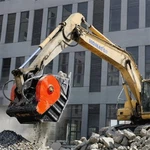


Excavator Soil Mixer
Product Specifications
|
Model |
Applicable Excavator |
Reached Depth |
Efficiency |
|
MT-200 |
20-25MT |
1-3M |
40-70m³/hour |
|
MT-250 |
25-30MT |
1-5M |
40-70m³/hour |
|
MT-300 |
30-36MT |
1-7M |
50-90m³/hour |
Product Features
Hydraulic Drive and Intelligent Control
The Motek mixing head is directly driven by the excavator's hydraulic system. Equipped with dual hydraulic motors and an automatic torque adjustment valve, it automatically adjusts power output based on soil or material hardness, ensuring efficient mixing in diverse working conditions (e.g., soft soil, hard soil, or silt). The mixing head features built-in sensors for drum speed, temperature, and oil leak detection, providing real-time data feedback to the excavator cab, allowing the operator to precisely control mixing depth, speed, and stability, enhancing operational safety and controllability.
Optimized Mixing Structure Design
Y- or V-shaped blade design: Enhances penetration and reduces resistance in hard formations. It also ensures zero blind spots (e.g., the angle between the left and right hinged blades is only 1 cm), achieving uniform mixing in three dimensions.
Bidirectional Rotation: The mixing head rotates clockwise to mix and inject curing agent, while rotating counterclockwise to further mix the material, preventing slurry sticking and ensuring deep mixing and smooth equipment removal.
Wear-Resistant Material and Construction: Constructed of high-strength, wear-resistant steel, it withstands high-abrasion environments (such as gravelly soils or corrosive silt) and extends service life. The frame design balances lightweight and rigidity, balancing excavator load and operational flexibility.
Modularity and Expandability
The mixing head is compatible with excavators of various tonnages (typically ≥20 tons is recommended for suction and stability requirements). Extensions (2–6 meters) extend the mixing depth to a maximum of 8 meters underground, meeting varying project depth requirements. Furthermore, curing agent or chemicals are delivered directly to the mixing nozzle via connecting pipes (e.g., 80mm diameter pipes), enabling precise addition and mixing of dry or wet materials.
Advantages
Efficiency and Cost-Effectiveness
In-Situ Processing Reduces Transportation: Soil, silt, or waste materials are mixed directly on-site, eliminating the need for additional excavation, transportation, or on-site stockpiling, significantly reducing material handling costs and the risk of secondary contamination. Multifunctional Integration: A single excavator can be used for multiple tasks, allowing users to switch mixing heads to perform solidification and stabilization operations, reducing equipment idleness and the cost of renting or purchasing additional specialized machinery. Fast Construction Cycle: Automated control and powerful power shorten mixing time, making it particularly suitable for large-scale foundation treatment or emergency projects.
Environmental Protection and Quality Advantages
Zero-Emission Processing: Silt or contaminated soil is solidified in-situ, avoiding the environmental pollution associated with traditional treatment methods (such as incineration and landfilling). The enclosed mixing design reduces dust and chemical leakage. Uniform and Stable Effect: Precisely controlled mixing parameters (depth, speed, and dosage) ensure uniform strength in the solidified layer, improving foundation bearing capacity and enabling material resource utilization (e.g., treated soil can be used as a road base or fill).
Operational and Adaptability Advantages Flexibility
The excavator's crawler or tire chassis allows for easy access to narrow, soft, or complex terrain (such as river channels, swamps, and backfill areas), enabling efficient operation even in areas difficult to reach with traditional mixing equipment.
Intelligent Control
The integrated operator interface in the cab simplifies manual intervention and reduces operator skill requirements; the real-time feedback system facilitates quality monitoring and adjustments.
Applications
Civil Engineering and Infrastructure
Soft Foundation Reinforcement: During the construction of roads, railways, airport runways, or building foundations, soft soils with high water content, backfill, or silt layers are mixed in situ, and curing agents such as cement and lime are injected to enhance bearing capacity. Dyke and Slope Stabilization: Reinforce the foundations of river channels, lake embankments, or areas prone to landslides to prevent soil erosion and structural instability.
Environmental Remediation and Management Contaminated Soil Remediation
Mix heavy metal-contaminated or organic-contaminated soil with remediation agents for harmless stabilization. Silt Resource Utilization: Silt generated from dredging of rivers, sewage treatment plants, or ports is treated and solidified, then converted into engineering fill or ecological materials (such as constructed wetland substrates). Solid Waste Stabilization: Mixing and blending industrial waste residues, landfill cover soil, and other materials to reduce leachate risks and space usage.
Municipal and Public Works Pipeline Trench Backfill
Mixing and compacting the backfill area after pipeline laying prevents settlement and pavement cracking; suitable for narrow urban construction zones. Temporary Road and Construction Platform Construction: Rapidly treat soft surfaces to create high-strength temporary pavements that support the passage of heavy machinery.
Agricultural and Ecological Engineering
Soil Improvement: Mixing organic fertilizers, lime, or conditioners improves farmland soil structure, particularly suitable for large-scale land remediation projects. Composting and Biological Treatment: Mixing and aerating organic waste compost accelerates fermentation and maturation, achieving resource recycling.
About Us
Anhui Motek Construction Machinery Co., Ltd. is top manufacturer in China on construction machinery attachments, established in 2014.
Motek always pays attention to product research and development, constantly produces new products with market demands to improve product performance and quality.


FAQ
Can I visit your factory?
Sure, we welcome your visit.
Please let us know your schedule in advance so that we can make appropriate arrangements.
What is your factory's production capacity per month/year?
Our monthly production capacity is approximately 50 units, and the annual capacity can reach 600 units. However, it can be adjusted based on specific orders and production arrangements.
Hot Tags: excavator soil mixer, China excavator soil mixer manufacturers, suppliers, factory, Soil Mixing Machine, soil stabilization project, ground improvement for slopes, soil strengthening products, soil strengthening test, earth stabilization supplier
Previous
Power MixerYou Might Also Like


Send Inquiry