

I. From Demolition Waste to Jobsite Resource
Construction sites are becoming more demanding. Contractors are expected to complete demolition, site clearance, material handling, and backfilling within tighter schedules, while also controlling transport costs and reducing the amount of waste sent away from the jobsite.
This is creating a new requirement for mid-to-heavy excavator fleets: attachments must do more than perform a single operation. They must help contractors reduce unnecessary material movement and convert suitable demolition waste into a usable resource as close as possible to the point of excavation.
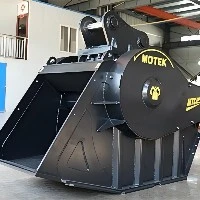
MOTEK responds to this challenge with the MTC250 Hydraulic Crusher Bucket. Developed for 21–32 ton excavators, the MTC250 is designed to bring primary material processing directly into demolition, renovation, roadwork, quarrying, and recycling operations. Instead of treating concrete and stone as materials that must immediately be transported away, contractors can process them on site and make better use of the existing excavator fleet.
II. The Productive Middle Ground: Engineered for 21–32 Ton Excavators
The MTC250 is positioned for contractors who need substantial crushing capacity but do not want to move up to an oversized attachment designed for the largest excavator class.
With an operating weight of 3,700 kg, the MTC250 provides a solid working platform for 21–32 ton excavators. Its overall dimensions of 2,550 × 1,430 × 1,750 mm are configured for a powerful attachment that remains aligned with the operating range of its carrier machines.
The 0.95 m³ bucket capacity supports a practical balance between loading volume, crushing efficiency, and excavator stability. This makes the MTC250 suitable for contractors handling reinforced concrete, masonry, natural stone, and other mineral-based materials in applications where every additional handling step affects the final project cost.
Rather than focusing only on maximum size, MOTEK has developed the MTC250 around a more practical question: how can a 21–32 ton excavator generate more value from each working hour? The answer lies in combining a serious crushing attachment with the carrier's existing mobility, reach, and loading capability.

III. Hydraulic Matching: Turning Excavator Power into Consistent Output
Hydraulic compatibility is a decisive factor in attachment performance. A crusher bucket that is not properly matched to the excavator can lead to unstable operation, unnecessary heat generation, or inefficient use of available power.
The MTC250 operates at a working pressure of 220–280 barand requires a hydraulic flow rate of 180–220 L/min. These parameters allow contractors and equipment dealers to assess compatibility clearly before installation and select the right excavator configuration for the application.
The return oil pressure is maintained at less than 5 bar. This low return-pressure requirement helps reduce resistance in the hydraulic circuit and supports smoother oil circulation during continuous crushing work. When the hydraulic system is correctly configured, the excavator can deliver power more efficiently, while the attachment remains responsive during repeated loading and crushing cycles.
For fleet managers, this hydraulic profile also simplifies equipment planning. The MTC250 can be evaluated not only by its crushing capacity, but by its ability to integrate into the hydraulic specifications already available across a 21–32 ton excavator fleet.
IV. A Mobile Processing Station for Changing Jobsites
Large recycling plants remain important, but not every jobsite has the volume, access, or schedule needed to justify transporting all material to a fixed facility. Urban renovation projects, bridge maintenance, road reconstruction, and remote civil works often require a more mobile solution.
The MTC250 turns the excavator into a movable processing station. It can follow the work area, process material near the demolition point, and reduce repeated loading and unloading between machines. This is particularly valuable when site space is limited or when temporary stockpiles would interfere with construction progress.
By crushing suitable concrete and stone close to where they are generated, contractors can improve the internal flow of material. Processed output may then be directed toward backfilling, temporary access roads, site leveling, drainage layers, or other project-specific uses, subject to local engineering requirements and material testing.
This operating concept changes the role of a crusher bucket. It is not simply an attachment for breaking waste; it is a tool for reducing the distance between demolition and reuse.
V. Lower Handling Costs Through Process Simplification
In many projects, the cost of demolition waste is not limited to crushing. It also includes loading, trucking, disposal fees, replacement aggregate, and the time spent coordinating multiple pieces of equipment.
The MTC250 supports a simplified material workflow:
• Process closer to the source: Reduce the need to move every load of concrete or stone to a distant processing point.
• Reuse suitable material: Create opportunities to use processed mineral material within the same project.
• Improve excavator utilization: Add a crushing function to a carrier that is already present on site.
• Reduce intermediate handling: Minimize repeated loading, stockpiling, and reloading operations.
• Support tighter project scheduling: Keep material processing closer to the construction sequence.
For contractors working with 21–32 ton excavators, this can translate into a more controlled cost-per-ton strategy. The precise return depends on material type, operating hours, transport distance, local disposal charges, and the final use of the processed material, but the commercial principle is clear: every avoided handling step can improve the economics of a project.
VI. Built for Practical Integration and Long Working Cycles
A crusher bucket must work as part of a complete excavator system. Carrier weight, hydraulic pressure, oil flow, return circuit design, attachment setup, and operating conditions all influence the final result.
MOTEK positions the MTC250 as an integrated solution for equipment dealers, rental companies, demolition contractors, recycling operators, and civil engineering fleets. Before delivery, the attachment specification should be matched with the excavator's hydraulic system and the customer's intended material-processing requirements.
With its 3,700 kg operating weight, 0.95 m³ capacity, 220–280 bar working pressure, 180–220 L/min flow requirement, and less than 5 bar return oil pressure, the MTC250 gives professional users a clear technical basis for equipment selection and hydraulic commissioning.
The result is a more focused machine combination: a 21–32 ton excavator with the reach and mobility to work across the site, paired with a crusher bucket capable of supporting on-site material recovery.
VII. A Smarter Route for the Next Generation of Construction Recycling
The future of construction recycling will not depend on one machine or one processing location. It will depend on how efficiently contractors connect demolition, material handling, crushing, and reuse within the same project cycle.
The MOTEK MTC250 Hydraulic Crusher Bucket is designed for this transition. By bringing controlled crushing capability to 21–32 ton excavators, it helps contractors move from a disposal-first mindset toward a more flexible model of local processing and resource recovery.
For companies seeking to reduce material transport, improve fleet productivity, and create greater value from demolition waste, the MTC250 offers a practical step toward more efficient and circular jobsite operations.
MOTEK MTC250 Hydraulic Crusher Bucket - turning excavator mobility into on-site material value.


